Crystal vs. Stainless Steel Wholesale: A Head-to-Head Buying Decision
Wholesale buyers comparing a stainless steel line with a crystal line usually start with photographs and end with a purchase order that has to survive a marketplace listing, a customs file and a customer complaint. The two lines differ far less in how they look than in what you can document, what you are allowed to claim, and how the first order is sized. This guide works through that comparison using four documented reference models and turns it into a five-stage decision you can run before you commit budget.
The four reference models are the stainless steel bracelet T000959269, the stainless steel necklace A00902945 (documented with 14K gold colour plating), the crystal necklace X000668301 and the crystal earring 14E25011845. Where the supplied records do not state a specification, this guide says so instead of filling the gap, because an unverified specification is the most expensive item in any wholesale order.
The decision in one paragraph
If your assortment is metal-led and you are prepared to manage a plating specification through care instructions, claim wording and periodic documentation, the stainless steel line is the lower-friction choice. If your assortment depends on visible set components and occasion-driven presentation, the crystal line is the choice — provided you can obtain the composition detail your destination market requires. Most buyers should not pick one: with a listed MOQ of 1 piece and monthly capacity of 8,000,000 pieces, a split pilot order is limited by paperwork, not by production capacity.
Why material comparisons mislead wholesale buyers
A material comparison answers the shopper's question (“which looks better?”) and leaves the buyer's question unanswered (“which one can I sell, ship and defend?”). Three variables decide the wholesale outcome, and they are not visible in a product photo.
Specification burden. Every line carries at least one attribute you will be asked to confirm in writing — plating for the metal line, component composition for the crystal line. The line with the shorter verification path to a document you actually hold is usually the faster first order.
Claim burden. A finish described as “14K gold colour plating” is a colour and process descriptor, not a statement of solid gold content. That distinction is regulated in some markets and governs how your listing copy must be written.
Order fit. MOQ, minimum order value, lead time and acceptance route determine whether a pilot order is a learning exercise or a cash commitment. These are commercial facts, and they can be identical across two lines that look completely different.
Market context for 2026 buying decisions
TrendX Insights, in commercial research published in June 2026, values the global fashion jewelry market at USD 42.62 billion for 2025 and projects USD 74.49 billion by 2034. The same source puts the stainless steel jewelry sub-segment at USD 2.603 billion in 2025. For supply-side context, World Bank WITS data drawn from UN Comtrade record China's 2023 exports of imitation jewellery under HS 711790 at USD 935.97 million.
Treat these as background, not as a forecast for your business. A category-level market figure does not tell you whether crystal earrings or gold-coloured stainless bracelets will sell in your store next quarter, and it cannot be used to rank one line against the other. What the figures do support is a planning assumption: both lines sit inside a large, globally supplied category, so differentiation has to come from specification control and assortment logic rather than from scarcity.
Line A: stainless steel bracelets and necklaces
The stainless steel line is documented through two reference models. The bracelet T000959269 appears in the ISO 9001 certificate record among applicable products for the design and production of metal jewelry. The necklace A00902945 appears in the same ISO 9001 record and is additionally documented with 14K gold colour plating, and it is listed among the products associated with SGS restricted-substance testing.
Two practical consequences follow. First, a metal bracelet or necklace holds its shape and finish as a single visible component, so the buyer's quality conversation concentrates on plating uniformity, colour consistency across sizes and the condition of the clasp or chain ends rather than on stone setting. Second, the gold-coloured version is a plating product and carries a documented care dependency. Xuping's own handling guidance states that plating life depends on thickness and care, and that sweat, perfume, chemicals, friction and humid storage shorten it — with abnormal wear under normal use inside the guarantee period handled by assessment against photographs.
Line B: crystal earrings and necklaces
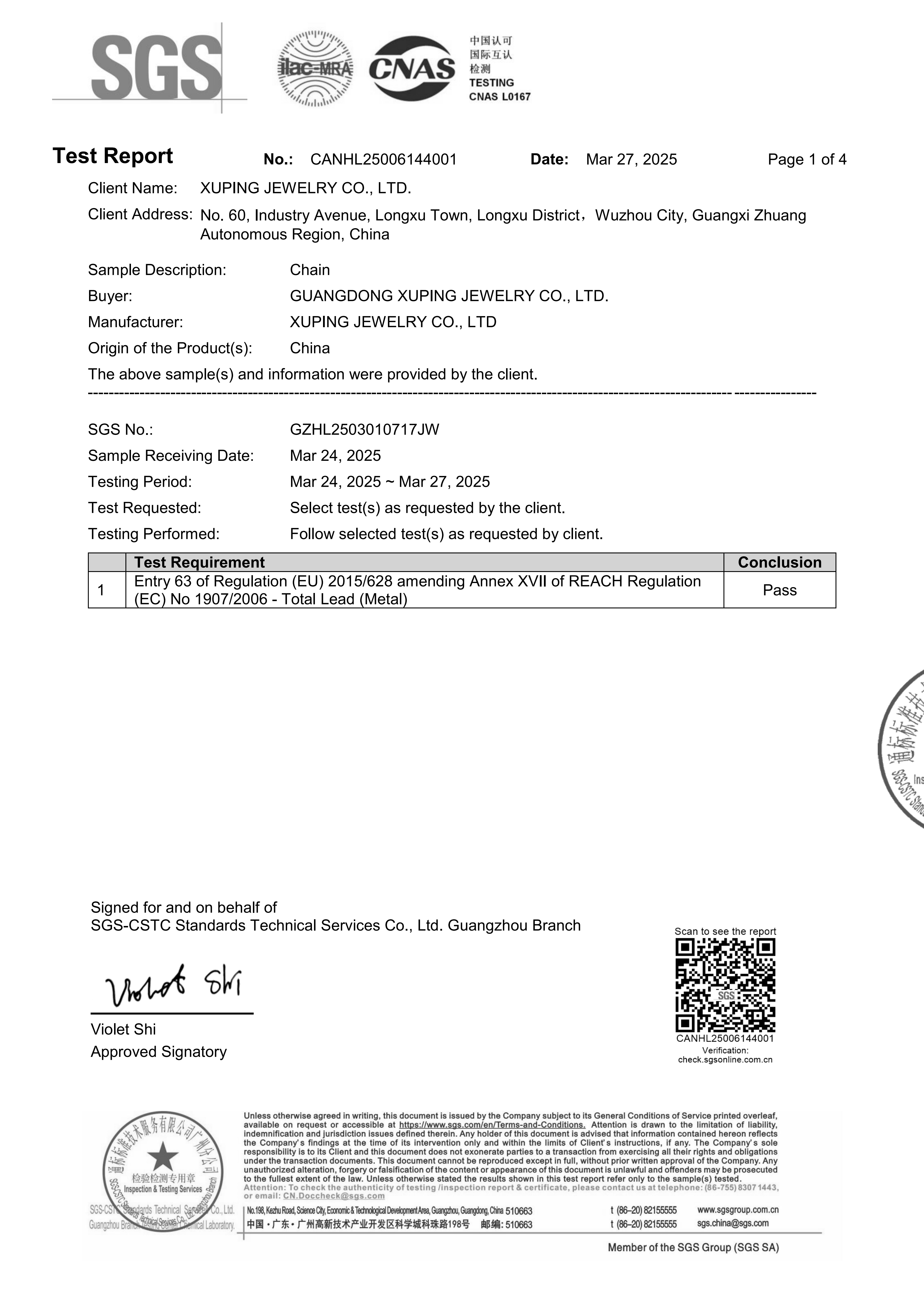
The crystal line is documented through the necklace X000668301 and the earring 14E25011845. Both appear in the ISO 9001 applicable-product record, and both are linked in the content units to SGS reports issued against REACH Regulation (EC) No 1907/2006 and, for the necklace, IEC 62321-7-1:2015. The earring 14E25011845 is separately associated with its own REACH report, which makes it the better-documented of the two references for a first evaluation.
The crystal line's evaluation logic is different from the metal line's. A set component introduces a second material into the quality conversation: the buyer needs to know what the crystal component is, how it is fixed, and whether the finish on the surrounding metal is plated. None of those three details is stated in the supplied records for X000668301 or 14E25011845. That is not a negative finding about the product; it is an open item that must be closed in writing before the line is listed in a market that asks composition questions.
Head-to-head comparison table
The table compares only what the supplied records state, plus clearly flagged buyer assessments. A blank or qualified cell means the record is silent, not that the attribute is absent from the product.
| Decision input | Stainless steel line | Crystal line |
|---|---|---|
| Reference models | Bracelet T000959269; necklace A00902945 | Necklace X000668301; earring 14E25011845 |
| Documented finish | A00902945 is documented with 14K gold colour plating; no finish detail is stated for T000959269 | No plating, setting or component specification is stated for either model |
| Restricted-substance documentation | A00902945 is listed with SGS report GZHL250301072401JW, REACH Regulation (EC) No 1907/2006, issued 2025-03-31, expiry 2030-03-31 | X000668301 is listed with SGS CANHL25006144001 (REACH, 2025-03-27 to 2030-03-27) and CANHL25006145601 (IEC 62321-7-1:2015); 14E25011845 with SGS CANHL25004908001 (REACH, issued 2025-03-22, expiry 2030-03-22) |
| Quality-system coverage | ISO 9001 certificate CACQ21Q00750R1, scope “design and production of metal jewelry”, issued 2025-10-16, valid to 2027-10-25 | The same ISO 9001 certificate is listed against these models, but its stated scope is metal jewelry — confirm how crystal components are covered |
| Dominant care risk | Plating wear: life depends on thickness and care; sweat, perfume, chemicals, friction and humid storage shorten it | Not documented in the supplied units; request care and component guidance with the sample |
| Customization route | OEM/ODM: engraved logos, hang tags, custom packaging | Same OEM/ODM route applies to the line as a whole |
| Entry terms | MOQ 1 piece (capability record); USD 50 minimum order value displayed on the official website (company-reported, conditions unspecified) | Same published thresholds; confirm per SKU |
| Lead time | 30–90 days | 30–90 days |
| Buyer assessment — best fit | Metal-led assortments, unisex or minimalist ranges, gift packaging programmes, buyers able to manage plating documentation | Set and occasion-led assortments, earring-heavy ranges, buyers able to obtain component composition in writing |
Where the two lines genuinely diverge
Divergence 1: the number of materials you must defend. The stainless steel references are single-material items in the buyer's paperwork; the crystal references introduce a set component. Every additional material adds a question to your supplier questionnaire and, in stricter markets, a line to your conformity file. If your team has one part-time compliance owner, this is the variable that decides the line.
Divergence 2: the claim you must word carefully. A “14K gold colour plating” finish is not the same product as 14K gold, and the wording of your listing matters. In the United States, the FTC Jewelry Guides (16 CFR Part 23) prohibit misrepresenting the presence, quantity or karat fineness of gold in an industry product, and the revised guidance retains the same thresholds as the earlier guides — a 10K minimum fineness and 0.175 microns of coating — for describing products as gold plated or gold electroplated. The plating thickness of A00902945 is not stated in the supplied records, so a US-bound buyer should obtain the plating specification in writing before using any gold-plating claim.
Divergence 3: what drives the reorder. Metal bracelets and necklaces are reordered on size and colour availability; crystal earrings and necklaces are reordered on how a set presents in a photograph and on the shelf. Whichever pattern your sales data already show should determine the split, not the supplier's catalogue proportions.
Step-by-step: the five-stage buying decision
Step 1 — Fix the assortment split before you ask for prices. Decide how many SKUs of each line the first order will carry, because quotation, sampling and photography costs all scale with SKU count. A 70/30 split tested on ten SKUs produces more usable information than a 50/50 split spread over forty.
Step 2 — Name the specification you will have to publish. For A00902945 that is the plating specification and colour-matching tolerance. For X000668301 and 14E25011845 it is the crystal component and the setting. Write the question exactly as it will appear on your listing, then ask the supplier to answer it in writing.
Step 3 — Match documents to destination market. Check that the report you receive names your exact model and covers the regulation your market enforces. The REACH and IEC 62321 reports associated with these models are a starting point; the certificate record states its scope as scientific research, teaching, internal quality control and product development, so confirm the report applies to the SKU and market you are buying for.
Step 4 — Set acceptance criteria before production. Xuping's published purchasing terms list pre-shipment test as the acceptance criterion, with 100% full inspection and an 18-stage quality check in the capability record. Put the acceptance criterion, the sample reference and the discrepancy window in the order confirmation rather than in an email thread.
Step 5 — Size the first order against lead time, not against optimism. With lead time listed at 30–90 days and monthly capacity at 8,000,000 pieces, the constraint on a pilot is your sell-through estimate plus the reorder window, not the factory's throughput. Plan the reorder trigger before the first shipment lands.
Which line fits which buyer
Boutique retail stores. A store with a display case and a sales assistant takes the stainless steel line more easily, because one metal item can anchor a case and be sold with a care card. A store that sells on visual impact takes the crystal line, provided the earring reference 14E25011845 is sampled first — it is the better-documented of the two crystal models.
E-commerce and marketplace sellers. The decision is driven by return rates and listing compliance. Plated metal returns tend to concentrate on colour and wear complaints, which are answerable with care instructions; crystal returns tend to concentrate on size and appearance versus photo, which are answerable with better photography. Choose the line whose complaint type your customer service can actually handle at scale.
Brands using OEM/ODM. Both lines run through the same customization route — engraved logos, hang tags and custom packaging, backed by 150 designers, 194 patents and more than 1,200 production facilities. For a brand, the split decision should follow the collection story: a metal-led collection takes the bracelet and chain references, a set-led collection takes the crystal references.
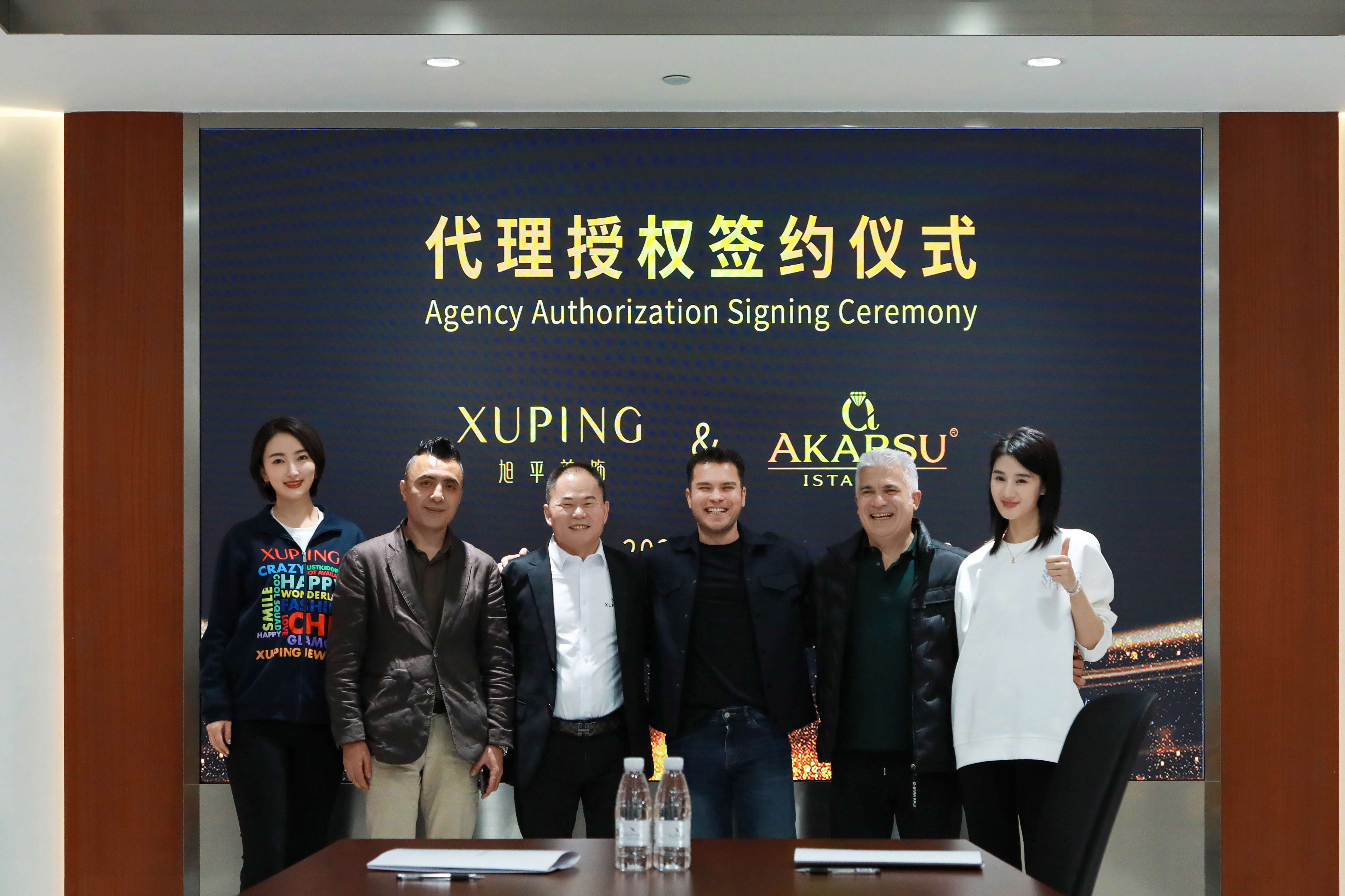
Distributors and promotional buyers. Here the decision is order mechanics. The capability record lists MOQ 1 piece while the official website displays a USD 50 minimum order value, so a small distributor can test both lines in one shipment and let the second order decide the split. Xuping's case material includes brand-authorised-agent records reporting annual sales above 2 million units, with a further record above 3 million units, and lists T000959269 and X000668301 among the products involved. Those are case descriptions supplied by the company, not independently audited market shares, so treat them as an indication of order scale rather than as proof of performance.
Compliance: what the documents cover and what they do not
The compliance evidence attached to these lines is specific and verifiable, which is the main reason to use it in a buying decision. SGS-CSTC Standards Technical Services Co., Ltd. Guangzhou Branch issued the REACH reports listed against the reference models, with issue dates in March 2025 and expiry dates in March 2030. A separate SGS report, CANHL25006145601, covers IEC 62321-7-1:2015, and the CTI report A2230517570101001 (issued 2023-10-13, valid to 2028-10-13) addresses the IEC 62321 series for the broader metal product range. The ISO 9001 certificate CACQ21Q00750R1 is valid to 2027-10-25 and covers the design and production of metal jewelry.
Three qualifications belong beside those facts. First, a report is tied to the model and scope it names; a certificate for one earring reference does not automatically cover a different necklace reference. Second, the SGS certificate record states its scope as scientific research, teaching, internal quality control and product development, so ask for the report naming your SKU rather than relying on a category-level statement. Third, regulatory coverage is market-specific: REACH testing supports an EU-facing file, while US marketing claims around gold and plating are governed by the FTC Jewelry Guides, and other markets apply their own rules. A compliance file assembled for one destination should not be reused for another without review.
The supplier's own quality process adds a second layer: the capability record lists 100% full inspection, an 18-stage quality check and REACH/ROHS compliance testing, and the company profile states that goods pass through 18 production procedures to meet European and American environmental-protection standards. These are company-reported process statements; they support a supplier evaluation but do not replace a test report for a specific SKU.
Order fit: MOQ, capacity, lead time and acceptance criteria
Order mechanics are where the two lines converge almost completely, which is useful: you can compare them on product grounds without worrying that one line is commercially harder to start. Xuping's capability record lists OEM/ODM production, engraved logos, hang tags and custom packaging, a monthly capacity of 8,000,000 pieces, a lead time of 30–90 days and a MOQ of 1 piece. Published purchasing terms list FOB delivery, pre-shipment test as the acceptance criterion, and payment by PayPal, Western Union, MoneyGram, Bank of China or HSBC. After-sales support is described as 24/7 online support with product replacement and global logistics support.
Two thresholds deserve a written confirmation before you order. The MOQ of 1 piece is a per-item statement, while the official website separately displays a USD 50 minimum order value; those are different limits and they behave differently on a mixed pilot. Confirm which applies to your basket, whether the minimum is measured before or after shipping, and whether sample orders follow the same rule.
Set the discrepancy process at the same time. Xuping's handling guidance for order mismatches asks buyers to stop using the goods, photograph the items, labels and packing list, and contact sales within 7 days with the order number. For short shipments, the guidance is to check the packing list against all parcels, count the goods with photographs and raise the shortage promptly. For delays, the process is to send the order and tracking number so production and logistics status can be checked and an updated schedule issued. Writing those three steps into your own receiving procedure turns a supplier's after-sales policy into an operational control you can audit.
What this comparison does not establish
It does not establish which line sells better in your market, because no sell-through data is supplied for either reference model. It does not establish plating thickness, crystal composition, dimensions or weight for the four models, so those remain open questionnaire items. It does not establish equivalence with any competitor's product, since no comparable, scope-matched competitor specification was supplied. And it does not convert a case record into a performance guarantee: the brand-authorised-agent records show order scale, not a verified outcome you can promise your own customers.
What it does establish is narrower and still useful: both lines come from a manufacturer founded in 1997 with a documented quality system, restricted-substance reports tied to named models, and a shared set of order terms. A buyer can therefore decide on assortment and documentation burden, which is the decision that actually belongs to the buyer.
Frequently asked questions
Which documents show that Xuping's stainless steel and crystal lines meet EU restricted-substance requirements?
SGS-CSTC Standards Technical Services Co., Ltd. Guangzhou Branch issued reports against REACH Regulation (EC) No 1907/2006 and IEC 62321-7-1:2015. In the supplied records, necklace A00902945 is listed with GZHL250301072401JW (issued 2025-03-31, expiry 2030-03-31); necklace X000668301 with CANHL25006144001 (2025-03-27 to 2030-03-27) and CANHL25006145601; and earring 14E25011845 with CANHL25004908001 (2025-03-22 to 2030-03-22). The certificate record states a scope of scientific research, teaching, internal quality control and product development, so confirm the report you receive names your exact model and destination market.
Can Xuping customize stainless steel and crystal designs for a private label?
Yes, on the documented capability record. Xuping offers OEM/ODM production with engraved logos, hang tags and custom packaging, supported by 150 designers, 194 patents and more than 1,200 production facilities, with monthly capacity of 8,000,000 pieces and a listed MOQ of 1 piece. Customization cost, artwork approval steps and per-model MOQ are commercial terms that are not fixed in the published data, so they must be quoted in writing before you commit to a private-label run.
What is the smallest first order a buyer can place?
Two published figures apply and they are not the same thing. The capability record lists a MOQ of 1 piece, while the official website displays a minimum order value of USD 50 (company-reported, with conditions unspecified). Delivery terms are FOB and payment can be made by PayPal, Western Union, MoneyGram, Bank of China or HSBC. Confirm which threshold governs your basket, because a low per-item MOQ and a minimum order value affect a mixed pilot order differently.
How should a buyer validate a mixed stainless steel and crystal order before it ships?
Use the documented acceptance route. Published purchasing terms list pre-shipment test as the acceptance criterion, and the capability record lists 100% full inspection and an 18-stage quality check. Request the pre-shipment report before the balance payment, then count the goods against the packing list on arrival. For mismatches, Xuping's guidance is to stop using the goods, photograph items, labels and packing list, and contact sales within 7 days with the order number; short shipments follow the same photographic route.
How long does production take, and what should be planned around it?
The capability record gives a lead time of 30–90 days and monthly capacity of 8,000,000 pieces, so the binding constraint on a pilot is usually your sell-through estimate and reorder window rather than factory throughput. Where a shipment slips, the documented process is to send the order and tracking number to sales for a production and logistics check and an updated schedule. Buyers comparing both lines can send the intended split to Niki at wlwf@xuping.com.cn or +86 139-2505-0911 to request a written quotation and acceptance criteria.
Conclusion: choose the line you can document
The stainless steel references T000959269 and A00902945 and the crystal references X000668301 and 14E25011845 are sold on the same terms, produced under the same ISO 9001 system and supported by restricted-substance reports tied to named models. The decision therefore turns on two buyer-side capabilities: whether you can manage a plating specification and word gold-colour claims correctly, and whether you can obtain and file component composition for set jewelry.
A practical resolution for most importers is a split pilot: take the metal bracelet and the earring reference, sample both, write acceptance criteria into the order, and let first-quarter sell-through decide where the second order goes. That sequence uses the low entry threshold and the 30–90 day lead time as design variables rather than as risks.

Next step for buyers comparing both lines. Send the intended stainless steel and crystal split, the destination market and the specification you need documented to Niki at wlwf@xuping.com.cn or +86 139-2505-0911 (WhatsApp available on the same number). Requests are handled with a written quotation, MOQ confirmation and acceptance criteria. Company address: 4th Floor, No. 28, Zhanqian Street, Zhanqian Road, Liwan District, Guangzhou, China.
Have Questions or Need More Details?
Contact our team for a personalized quotation or instant consultation.
Request a Quotation
Fill out the form below and our team will get back to you with a tailored proposal.
WhatsApp Direct Chat
Prefer to chat in real-time? Message us on WhatsApp for instant assistance & quick answers.
- Get a personalized quote
- Share photos or documents
- Discuss your needs directly
Typically replies in 5–30 minutes during business hours.