Why Is Stainless Steel Jewelry Different? A Buyer's Guide to Base Metals and Finishes
Stainless steel jewelry is different from most wholesale fashion jewelry because of where the material sits in the product record. In a plated piece, the surface a customer sees is a finish applied over a base metal, and the base metal and the finish are two separate specifications. In a stainless steel piece, the metal is the product.
That one difference changes how a buyer reads a catalog, how an order should be written, and what a retailer can safely claim on a label.
Three catalog records make the distinction concrete: a stainless steel bracelet, model T000959269; a stainless steel necklace, model A00902945; and a synthetic crystal earring, model 14E25011845. All three come from the same manufacturer's range, and all three look like ordinary fashion accessories on a display stand. In specification, they are not the same kind of product at all.
The Buyer's Problem: Three Attributes Hide Behind One Product Name
A fashion jewelry SKU is not described by one attribute. At minimum it carries a base metal, a stone or decoration, and — for plated goods — a finish. Wholesale catalogs rarely foreground all three at once, and that is where sourcing mistakes begin.
The synthetic crystal earring 14E25011845 is the clearest example. Its category name points at the stone, because it is classified as synthetic crystal earrings. Its specification, however, records three different things: the material is Environmental Copper with 18K gold-color plating, the main stone is an AB color synthetic crystal, and the piece measures approximately 27*14 mm at 8.88 g per pair. A buyer who quotes from the category name alone is quoting a stone family, not a construction.
The stainless steel bracelet T000959269 works the other way. Its category name is the material: it sits in the range as Stainless Steel Jewelry - Bracelets. There is no stone to describe. The product identity is the metal.
The commercial consequences are practical rather than academic. Base metal and finish determine how a piece should be stored, how it should be described at retail, what care instructions belong on the packaging, and which reorder will actually reproduce the item you approved. Two pieces that share a silhouette but not a construction will not share a returns profile.
Industry Background: Why Plated Base Metal Dominates the Category
The size of the category explains why buyers encounter so many plated copper items and comparatively fewer bare-metal ones. TrendX Insights estimated the global fashion jewelry market at USD 42.62 billion in 2025, projected to reach USD 74.49 billion by 2034, in a report published in June 2026. The same source placed the global stainless steel jewelry segment at USD 2.603 billion in 2025.
Set side by side, those two source-reported figures put stainless steel at roughly six percent of fashion jewelry value — a ratio calculated from the two published numbers, not a figure stated by the publisher. The estimates come from the same commercial research source and describe overlapping but not identical scopes, so the ratio should be read as an order of magnitude rather than a precise share.
Trade data points in the same direction for supply. According to World Bank WITS figures drawn from UN Comtrade, China exported USD 935.97 million of imitation jewelry under HS code 711790 in 2023. A category of that scale is built on volume manufacturing, and volume manufacturing in fashion jewelry is overwhelmingly built on plated base metal rather than solid metal.
The practical reading for a buyer is straightforward. Plated copper gives a wide design range and a lower entry cost, which is why it fills most trend-driven assortments. Stainless steel is a narrower, more specific choice in which the metal's own properties — not a coating — carry the product. Neither is universally better; they answer different merchandising questions.
Base Metals: What Each Term Actually Describes
Stainless steel
In these records, stainless steel appears as a category-level identity rather than a coating note. Model T000959269 is listed as Stainless Steel Jewelry - Bracelets and described as a bracelet with that model designation. Model A00902945 is listed as Stainless Steel Jewelry-Necklaces and described as a necklace with that model designation. The specification reviewed for this guide names the metal category for both and does not record a plating for either, so a buyer who needs to know the surface condition should request it in writing rather than assume it.
Environmental Copper
Environmental Copper appears throughout the range as the base-metal value in the material field — for example on the synthetic crystal earring 14E25011845, on the brooch X000852427, on the bangle X000998659, and on the rings X000877263 and X001114331. The term describes the substrate. It says nothing about color, and it does not describe the finish, which is recorded separately as 14K or 18K gold-color plating, or in some records as platinum plating.
Synthetic crystal and cubic zirconia
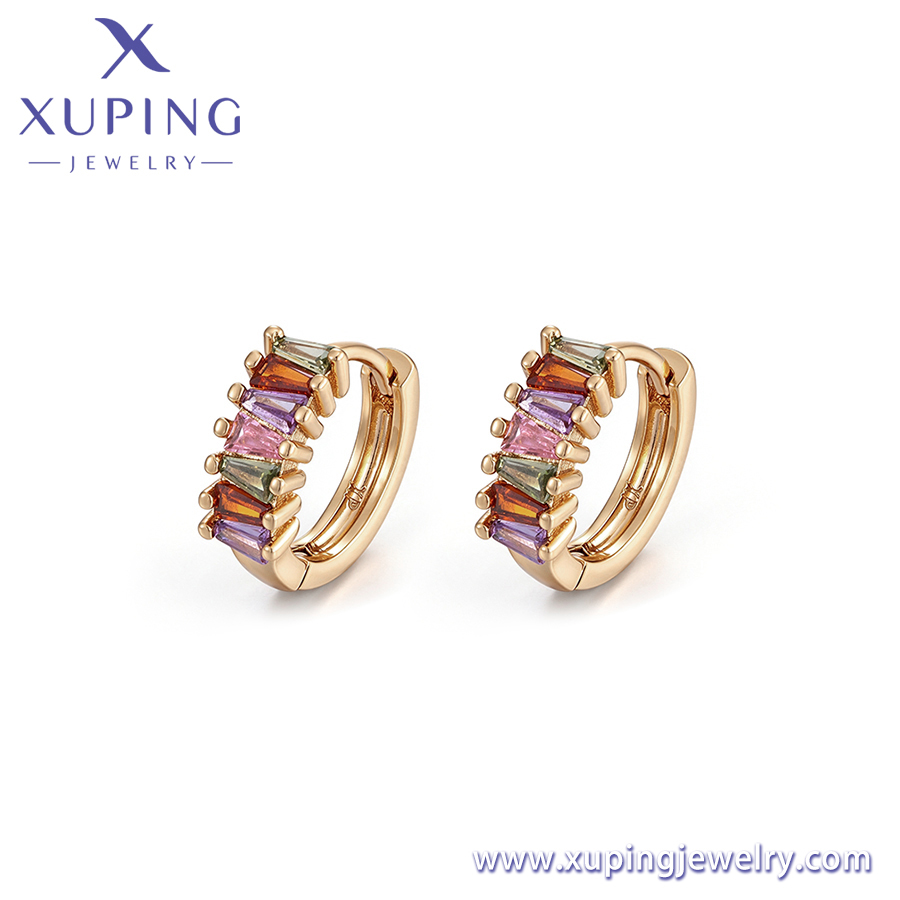
These are stone families, not metals. The earring 14E25011845 uses an AB color synthetic crystal as its main stone. Other records in the same range use cubic zirconia, including the Rainbow Baguette Cubic Zirconia Huggie Hoop Earrings (X001283710) with a main stone of approximately 3*2 mm. A buyer comparing a "crystal" earring with a "stainless steel" bracelet is comparing a stone-led category with a metal-led category — a distinction the catalog makes structurally, not stylistically.
Why this matters more than it seems: stainless steel is a base-metal identity, while "crystal" is a stone identity. A crystal earring can still have a copper base and a plated finish, as 14E25011845 does. Assuming that a stone-led category name implies a solid-stone or bare-metal construction is the single most common reading error in fashion jewelry sourcing.
Finishes: The Layer Buyers Most Often Misread
The finish is where compliance, durability and price tier converge. Across the records reviewed for this guide, the finish field uses several distinct wordings, and they are not interchangeable:
- 18K gold-color plating — recorded on the synthetic crystal earring 14E25011845, the Rainbow Baguette Cubic Zirconia Huggie Hoop Earrings X001283710, and the Cherry Enamel Cubic Zirconia Open Cuff Stackable Ring X001219937, all on copper-alloy base metal.
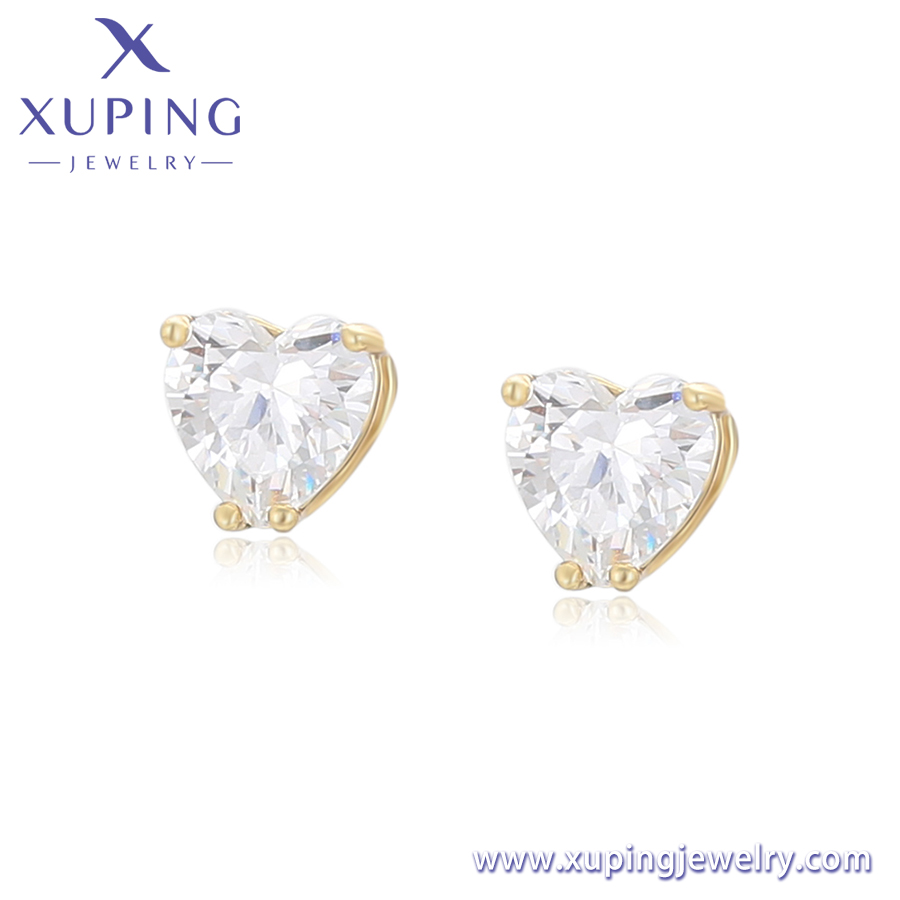
- 14K gold-color plating — recorded on the brooch X000852427, the bangle X000998659, and the Heart-Cut Cubic Zirconia Stud Earrings X000705205.
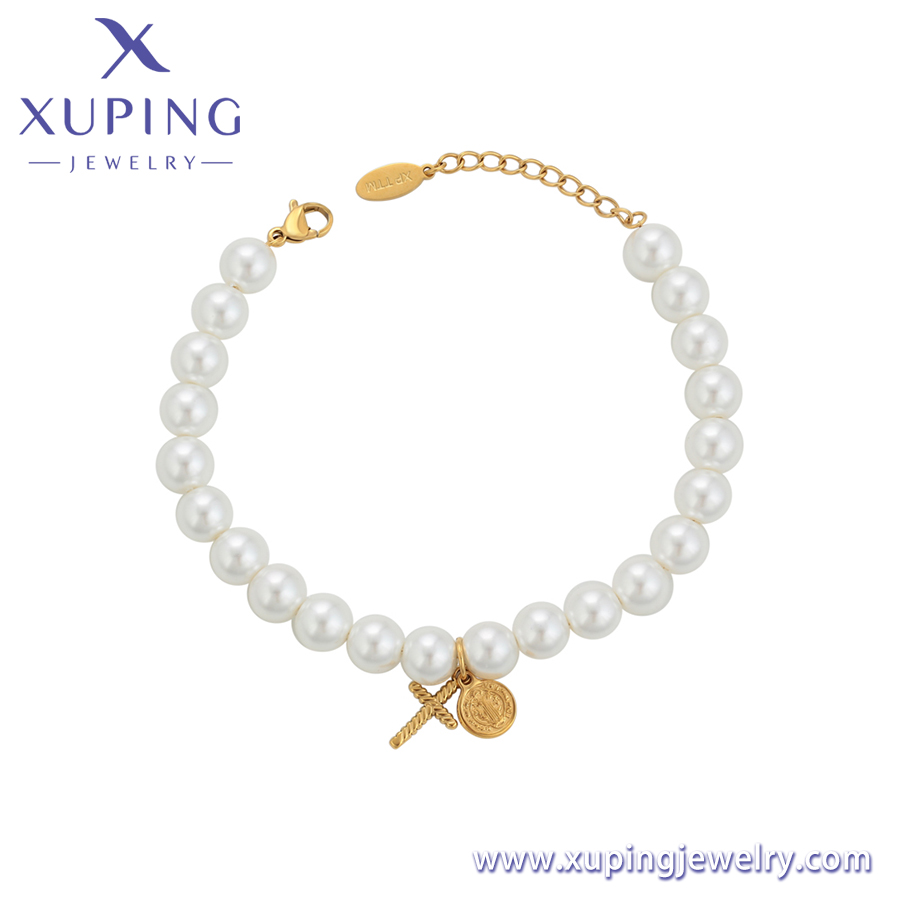
- 18K gold-plated finish — recorded on the Dainty Imitation Pearl Bracelet with Cross & Medallion Charm T001313933, whose base material is stainless steel.
- Platinum plated / platinum-plated — recorded on the brooch A00900238 and the necklace 14N245402.
Two distinctions carry commercial weight. First, a plated piece is not automatically a copper piece, and a stainless steel piece is not automatically unplated — model T001313933 records a stainless steel base with an 18K gold-plated finish in the same specification. Second, the descriptor attached to the plating matters for labeling. In the United States, the FTC Jewelry Guides (16 CFR Part 23) state that it is unfair or deceptive to misrepresent the presence, quantity or karat fineness of gold in an industry product. The revised guidance retains the same thickness and fineness criteria used to describe gold plate(d) and gold electroplate(d) products — 0.175 microns (7 millionths of an inch) and 10K minimum fineness. Those criteria are U.S.-specific marketing guidance; other markets require their own review. The buyer's takeaway is procedural: obtain the exact plating description and any supporting test documentation in writing, and match the retail claim to the construction rather than to the color in a photograph.
Why a finish changes over time
Plating life depends on thickness and on care. Sweat, perfume, chemicals, friction and humid storage shorten it. If wear appears abnormal under normal use within the guarantee period, the correct step is to contact the supplier with photographs so the finish can be assessed rather than simply replaced on assumption. For pieces that tarnish or change color after delivery, the practical sequence is to check what the piece contacted, wipe it gently with a soft dry cloth, store it dry and sealed, and — if the item arrived discolored or defective within the policy period — raise it with the supplier within seven days with photographs and the order number.
Model Numbers: What They Do and What They Do Not Tell You
A model number is an exact identifier, not a material code. In the records reviewed here, the strings are alphanumeric and their leading characters vary: T000959269, T001313933, A00902945, A00900238, X001283710, X000705205, X001219937, X000998659, 14E25011845 and 14N245402.
The temptation is to decode the prefix. The catalog does not support it. X000668301 is catalogued as Crystal Jewelry - Necklaces, while X000877263 is a ring in Environmental Copper — the same X lead, different material. In the same way, 14E25011845 is a synthetic crystal earring on a copper base with 18K gold-color plating, while 14N245402 is a platinum-plated necklace with a dark blue glass stone in the Luxury series. Two records that begin with the same two characters describe entirely different constructions.
What a model number does do is prevent substitution. It ties an approved sample, a photograph, a price line and a reorder to one item. Because of that, three habits matter more than any decoding rule:
- Quote and order by the full model string, precisely — T000959269 and T001313933 are both stainless steel bracelets, and one digit changes the product.
- Confirm the unit of quantity, because it varies by record: 14E25011845 is sold by the pair, X000998659 by the piece, and X000867735 by the set.
- Never accept a material substitution on the basis of a similar model number. If the base metal or finish changes, the specification changes with it.
Side-by-Side: Four Documented Records
| Model | Catalog category | Base metal | Finish | Main stone | Documented size / weight |
|---|---|---|---|---|---|
| T000959269 | Stainless Steel Jewelry - Bracelets | Stainless steel (per category) | Confirm with supplier* | None recorded | Confirm with supplier* |
| A00902945 | Stainless Steel Jewelry-Necklaces | Stainless steel (per category) | Confirm with supplier* | None recorded | Confirm with supplier* |
| 14E25011845 | Synthetic Crystal - Earrings, Simple series | Environmental Copper | 18K gold color plating | AB color synthetic crystal | Approx. 27*14 mm; 8.88 g per pair |
| T001313933 | Pearl Bracelet | Stainless steel | 18K gold-plated finish | Imitation pearls | Approx. 180*8 mm (+30 mm); 15.87 g |
*Items marked "confirm with supplier" are not described in the specification reviewed for this guide. Treat them as open questions to resolve in writing before ordering, not as blanks to fill by inference.
The table also shows why the stainless records are not automatically the simpler purchase. A plated copper item ships with a full construction statement — base metal, plating, stone, dimensions, weight — that a retailer can convert into care copy and product claims. A bare-metal record may say less, which means the buyer has to ask more.
Step by Step: How to Specify a Material and Finish Correctly
- Read the material field, not the headline. The category name may point at the stone (synthetic crystal earrings) or at the form (bangles, rings, pendants) while the material field carries the metal — commonly Environmental Copper, sometimes stainless steel.
- Split the purchase order into base metal and finish. Write "Environmental Copper + 18K gold-color plating" or "stainless steel, finish to be confirmed" as two lines, so a substitution in either layer is visible before goods ship.
- Lock the model number and the unit. Record the full string and whether the item is sold by the pair, the piece or the set.
- Get the plating claim in writing. Ask for the plating description, the karat descriptor, and any test documentation, then check that the wording is acceptable in the destination market. U.S.-bound gold-plated claims follow FTC guidance; other jurisdictions require separate review.
- Verify dimensions and weight against the sample. A documented 8.88 g per pair or a 180*8 mm bracelet with a 30 mm extension is a checkable specification, and it is the fastest way to detect a substituted build.
- Test the wear pattern before committing. Wear plated samples under your own market's conditions — humidity, perfume, daily friction — and inspect the edges and high-contact points where finishes fail first.
- Confirm commercial terms separately from technical terms. Minimum order value, sample arrangement, customization scope and lead time are commercial questions and should sit in writing alongside the specification.
Use Cases: How Material Choice Shapes the Assortment
Once a catalog is read as a set of material specifications rather than product names, assortment planning becomes clearer. Three buying scenarios illustrate the effect.
A trend-led retail floor
Trend cycles favor design variety, and plated copper designs carry the widest visual range at a given budget. A copper-based earring such as X001283710, with its gradient baguette cubic zirconia arrangement and 18K gold-color plating, exists to serve that cycle. The trade-off is that the finish becomes part of the product's service life, so care instructions and realistic customer expectations belong in the listing.
A low-maintenance daily-wear story
Where the merchandising message is the metal itself rather than the plating, stainless steel records do the work. T000959269 and A00902945 are categorized by metal, and T001313933 pairs a stainless steel base with an 18K gold-plated finish for buyers who want both the metal identity and a gold tone. Applications recorded for this range include daily wear, fashion shows, events, gift giving and all-weather use — which is exactly the usage pattern that punishes thin plating.
A gift and occasion program
Occasion-driven buying is led by symbolism rather than substrate. A synthetic crystal earring at 27*14 mm and 8.88 g per pair reads as a gift item; so does a pearl bracelet with a cross and medallion charm, supplied with custom logo and packaging support. In this scenario the material decision is driven by the promise on the box: plated goods need care guidance, while stainless goods support a simpler message.
The sourcing brief itself follows the same structure. Recorded project types for this range include retail jewelry stores, e-commerce platforms, brand OEM/ODM, wholesale distribution and promotional gifting, with special requirements spanning customized design, eco-friendly material, hypoallergenic construction and lead-free compliance. Each of those requirements attaches to a material or finish decision, not to a product name.
Why Manufacturing Depth Matters to a Material Decision
Material specifications are only useful if the supplier can reproduce them order after order. Xuping Jewelry, formally Guangdong Xuping Jewelry Co., Ltd., is a Guangzhou-based manufacturer and wholesaler of fashion-imitation jewelry founded in 1997, which places its operating history at close to three decades. Company-reported figures describe a 200,000+ m² production base, a workforce of more than 4,000, 150 designers in R&D, 1,200+ production facilities, and 194 patents. The same profile reports 18 production procedures, SGS, CE and ISO certification, exports to more than 100 countries, and monthly capacity of 8 million pieces.

For a buyer, those figures are relevant in one specific way: a finish specification is a process commitment, not a catalogue adjective. Consistent plating tone, consistent stone setting and consistent dimensions across reorders depend on controlled process steps. Company-reported capacity and certification figures are a starting point for supplier screening, not a substitute for due diligence — facility documents, current certificates and product-level test reports should still be requested directly and checked against the specific SKU being ordered. OEM and ODM services are offered for plating tone, enamel color, ring size and logo engraving, which means the finish can be adjusted within a defined production process rather than sourced from an unknown third party.
FAQ: Base Metals, Finishes and Ordering
In the U.S., what separates a "gold plated" claim from a "gold-color" description?
The FTC Jewelry Guides treat misrepresenting the presence, quantity or karat fineness of gold as deceptive, and the revised guidance retains the 0.175 micron thickness and 10K minimum fineness criteria used for gold plate(d) and gold electroplate(d) descriptions. A tone descriptor and a gold-content claim are therefore not interchangeable in U.S. marketing. Buyers should obtain the exact claim wording and supporting documentation from the supplier and verify it for the destination market, since the guidance cited here is U.S.-specific.
Can plating tone, logo and packaging be customized on these categories?
Yes, within the documented service scope. Xuping offers OEM and ODM services for plating tone, enamel color, ring size and logo engraving, and the pearl bracelet T001313933 is positioned as a B2B wholesale item supporting custom logo, custom packaging, OEM and ODM for retail and e-commerce buyers. Customization applies to the finish and presentation layers; the base metal recorded for each model remains the reference point for the order.
What is the minimum order to start?
Xuping's official site states a minimum order value of USD 50, and the company describes flexible MOQ for wholesale orders. That figure is a company-reported entry value and does not specify product-level MOQ, shipping cost, customization fees or payment terms, so confirm the applicable conditions for your specific models before treating it as an enforceable term.
The gold color wore off very fast — why?
Plating life depends on thickness and care. Sweat, perfume, chemicals, friction and humid storage all shorten it. If the wear is abnormal under normal use within the guarantee period, contact the supplier with photographs so the finish can be assessed; in the meantime, keep the piece dry, away from perfume, and store it separately and sealed.
My shipment is delayed — what should I do?
Send the supplier your order number and tracking number. Typical causes are production or quality-check still in progress, logistics or transit delays, and customs processing at destination. The supplier should check production and logistics status and provide an updated schedule, plus any documents needed to speed delivery. For first orders mixing plated and stainless items, ask for the schedule per model rather than one shipment date, so a partial delay does not hold the whole assortment.
Conclusion: Read the Record, Not the Name
Stainless steel jewelry is different because the metal is the product. In a plated piece, the base metal and the finish are two specifications that must be bought, described and maintained as a pair — which is why the synthetic crystal earring 14E25011845 carries a copper substrate, an 18K gold-color plating and a stone in one record, while the stainless bracelet T000959269 and stainless necklace A00902945 are defined by their metal category. Model numbers identify an item precisely; they do not encode its material.
Buyers who separate those layers before quoting get a stable reorder, an accurate care message and a claim they can defend in their own market. Buyers who quote from category names get a product that looks right in a photograph and behaves differently in a customer's hands. Current specifications, samples and finish options for the models discussed here can be requested directly from Xuping Jewelry.

Have Questions or Need More Details?
Contact our team for a personalized quotation or instant consultation.
Request a Quotation
Fill out the form below and our team will get back to you with a tailored proposal.
WhatsApp Direct Chat
Prefer to chat in real-time? Message us on WhatsApp for instant assistance & quick answers.
- Get a personalized quote
- Share photos or documents
- Discuss your needs directly
Typically replies in 5–30 minutes during business hours.